Video prompts: a 6-element method for getting the shot you want
Subject, action, setting, framing, lighting, sound. Describing these six elements in this order is enough to turn a random result into a usable shot.
Contents
Most failed prompts share the same flaw: they tell a story instead of describing an image. A video model doesn't read a screenplay. It builds a shot, a few seconds long, out of what you show it with words.
One shot at a time
Before you write, ask yourself one question: if I paused the video, what would I see? If the answer contains "then" or "after that," you're describing two shots. Split them up.
The six elements
- Subject. Who or what is on screen, with two or three visible details: age, outfit, color.
- Action. A single, simple gesture that fits within the length of the shot.
- Setting. The location, the time of day, the weather.
- Framing. The shot size and the camera movement.
- Lighting and style. Where the light comes from, and what look you want: film, documentary, animation.
- Sound. Ambience, sound effects, and the line of dialogue in quotation marks if there is one.
An example, before and after
Here's the kind of prompt people often write:
A sad woman in a city, cinematic, ultra realistic, 4K
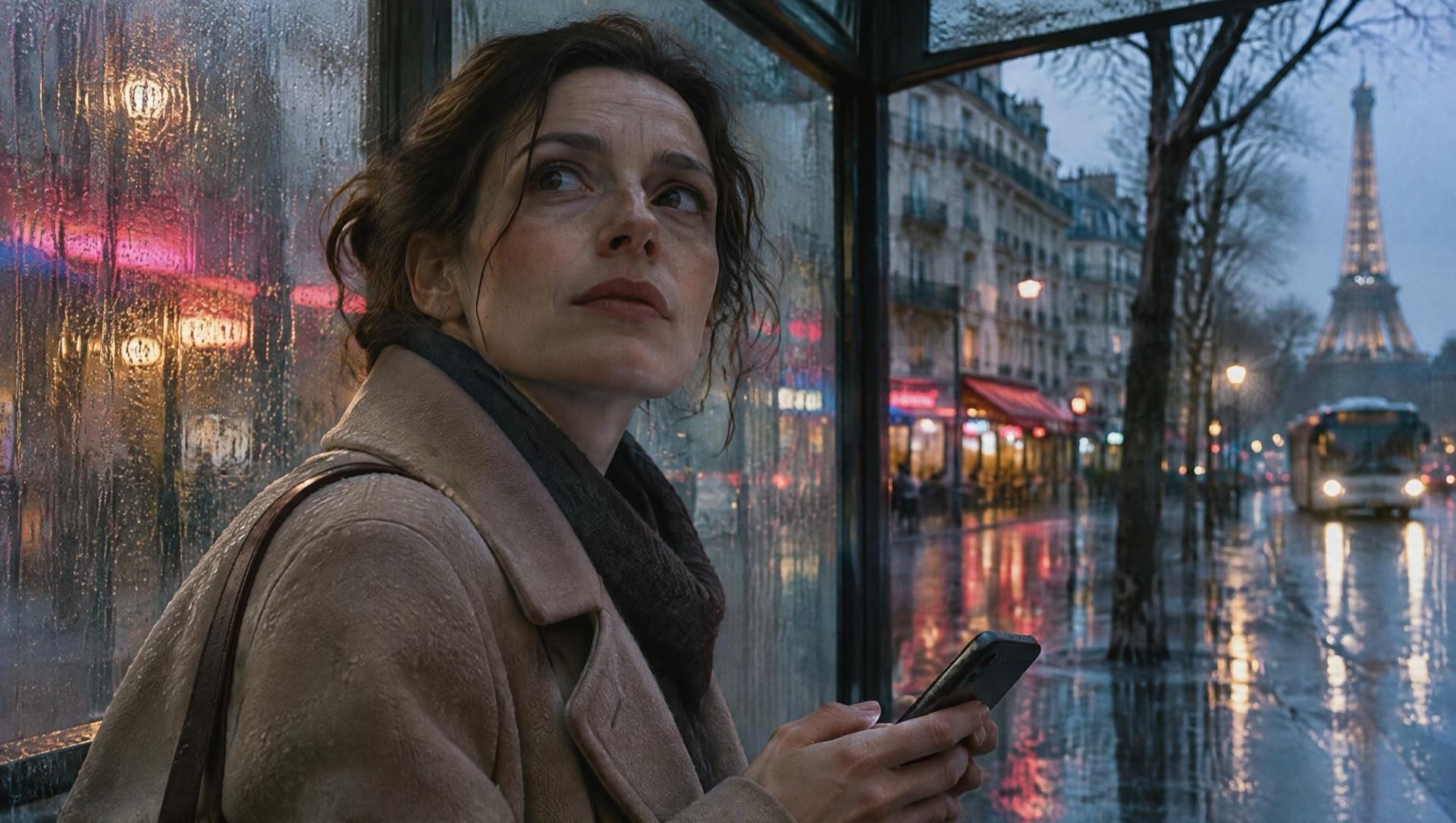
The model has to guess everything. Here's the same shot, described with all six elements:
A woman in her thirties, beige coat, brown hair tied back,
waits alone at a bus stop. She looks at her phone, then looks up
toward the street.
A Paris street in the rain, end of the day, shop signs lit.
Medium close-up at shoulder height, very slow dolly in.
Cold light, neon reflections on the wet sidewalk, 35mm film look.
Sound: rain on the bus shelter, distant traffic.
Not a single emotional adjective, and yet the sadness is there: it comes from the rain, the waiting, the cold light.
Write facts, not adjectives
"Gorgeous," "epic," and "cinematic" mean nothing to the model. Replace each adjective with what it means on screen:
| Instead of | Write |
|---|---|
| cinematic | shallow depth of field, 35mm film look |
| dramatic | backlighting, hard shadows |
| dynamic | handheld camera following the subject |
| warm | golden late-afternoon light |
Fix one element at a time
If the result isn't right, don't rewrite everything. Find the element at fault, change it, and run it again. It's the only way to understand what each word does, and to get better from one shot to the next.
Frequently asked questions
Do I need to write my prompts in English?
Most models understand prompts in other languages, French included, but they were trained mostly on English. For technical framing terms, English often gives more precise results. Try both on the same shot.
How long should a video prompt be?
Usually three to six sentences. Enough to cover all six elements, and no more: beyond that, the model starts choosing between your instructions.
This article was prepared with the help of AI, then checked and approved by Victor Lignel. How we use AI